

Independent agents are essential household and business risk advisors, and yet 60% of Ohioans place their personal automobile risks without the council of an independent agent. Independent agents (IAs) only place 40% of the private passenger auto (PPA) premiums in Ohio. How many of the 60% of Ohioans who did not use an IA know the intricacies of their various coverages? How many of the 36% of Ohioans who placed their PPA with a captive agent were aware of the difference between that agent and an independent one? Independent agents are the best risk advisors an Ohio citizen can find; they are local, reachable, and knowledgeable, and yet they have historically done the least business, percentagewise, with the most common risk facing Ohioans. It will take an industry-wide effort to increase the independent agent’s market share of PPA. Let’s dive into 2025’s PPA results and trends to help inform how we change the narrative around PPA with Ohioans.
2025 Personal Private Auto Landscape
Of Ohio’s 2025 property and casualty insurance marketplace, Private Passenger Auto (PPA), or personal auto insurance, is the largest line of business (LOB). Across all LOB in Ohio, $26.9B of premium is written; PPA accounts for $9.26B. Of this $9.26B, independent agents write just $3.75B (40%). Captive agents write $3.34B, and $2.17B goes direct.
PPA has been very profitable historically in Ohio and across the country. 2025 saw an adjusted loss ratio of 62% for PPA with the five-year average at a mere 67%. The dollars from this profitability often get funneled back into advertising, which is why many consumers are familiar with mascots like Jake from State Farm, the Gecko, Flo, and Limu the Emu (and Doug). Progressive, for example, spent a record-breaking $3.5B on advertising in 2024, when most of their competition was struggling. The majority of these marketing messages focus on price-based storytelling, which shapes the consumer’s thought process and can hurt an IA’s coverage-based approach.
The result of this money being spent on price-based insurance advertising: consumers gravitate towards direct insurers, leaving independent agents with only a fraction of the market. Meanwhile, independent agents dominate other major lines of business, such as commercial auto (90%) and commercial multi-peril (91%). In fact, the next smallest penetration rate for independent agents is homeowners multi-peril, which is at a 58% penetration rate. It’s clear that the independent agents dominate in more complex lines. The idea that PPA business is just a price-based commodity is something the industry must collectively educate against if IAs are to see their market share increase. Instead, the industry needs to educate the consumer about the value of the right coverage and the value of choice in PPA.
Another factor that contributes to agents’ low penetration rate in PPA is the fact that Ohio has the 49th lowest premium per capita out of 51 for personal lines across the US states and territories. So not only are agents fighting an uphill battle against consumers’ price-driven mindset, but when independent agents do win in PPA, they must sell more policies than agents in other states to make the same amount of commission. This low premium per capita is largely due to the rate environment in Ohio. Ohio is well-regulated, and our weather is, simply, insurance friendly.
The Last Five Years
The past half decade has been turbulent in our industry, but the market in PPA has softened. One piece of evidence of the softening market is 2025’s average premium increase by 2%, versus the 7% it has been averaging in the last five years. Of the major LOB, PPA had the smallest premium increase in 2025. This deceleration in premium increase signals that carriers in Ohio are satisfied with where their rates are for PPA. Carriers, especially the independent agent-friendly ones, need to continue to figure out how they can help their agents get PPA rates that are competitive with those of Progressive, State Farm, and GEICO, particularly as consumer sensitivity to premium has intensified.
Carrier Summary
Figures 1 and 2 summarize performance for the top 5 PPA carriers in Ohio.
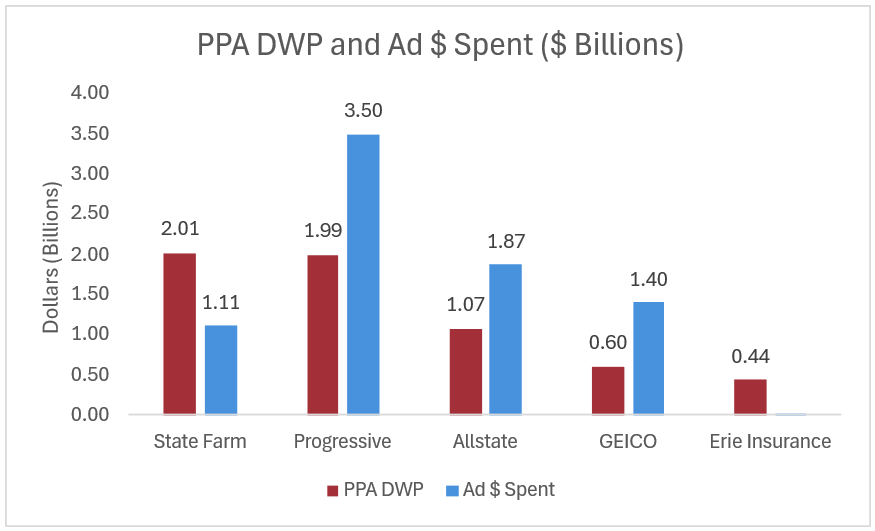
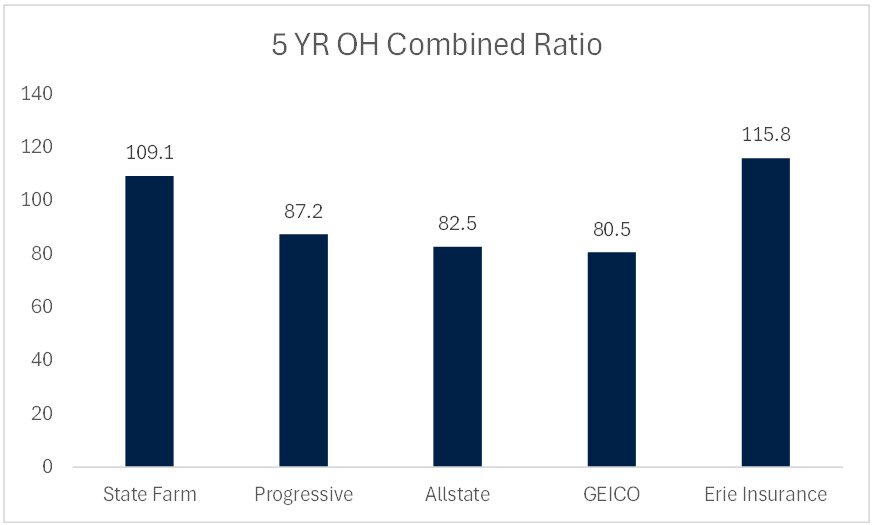
Of this group, Erie Insurance stands out as the only group that prefers the IA distribution model, showing their heavy investment into independent agents. However, their performance in the PPA market has been poor compared to the competition.
Erie’s struggle to compete reflects a common struggle of carriers that focus on the IA channel: they can’t compete pricewise against the rest of the Top 4 carriers. Many agents are appointed with Progressive as well, and agents constantly say it’s hard to beat their prices. Progressive, Allstate, and Geico’s five-year combined ratios have beaten carriers such as Travelers, Ohio Mutual, Western Reserve, Encova, Westfield, Auto-Owners, Cincinnati, Grange, and more.
The carriers being beaten by nationals are many of the leaders in Ohio’s independent agencies. If PPA market share for IAs is to increase, then the independent agent forward, Ohio-domiciled carriers, must help their agents by increasing the competitiveness of their PPA offerings in Ohio. This all starts with achieving better combined ratios than the nationals.
Factors Affecting the PPA Market in 2026
Looking ahead to 2026, there are two types of factors affecting independent agents focused on writing PPA: controllable and uncontrollable. Starting with factors they cannot control, including macro-economic trends and weather.
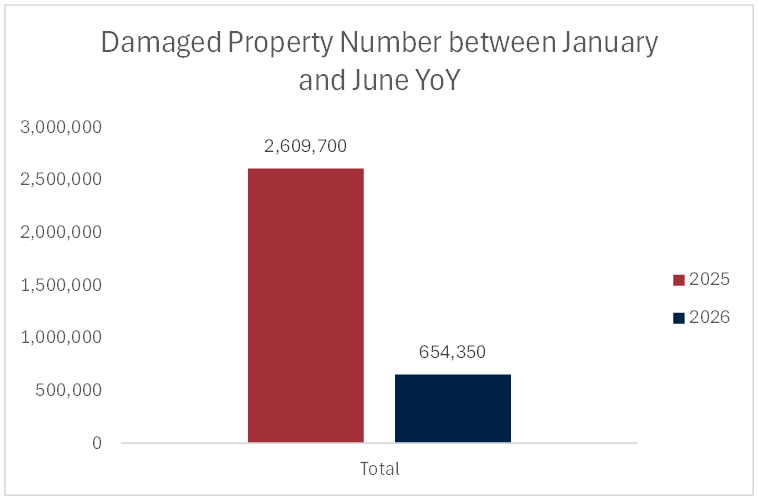
It looks like 2026 so far is on pace to be another insurance friendly weather year. Halfway through the year, the number of damaged properties in Ohio is way down from 2025. The first half of 2025 is when Ohio suffered much tornado activity, and the first half of 2026 has been relatively calm, comparatively. It looks like Ohio insurers should find another profitable year in 2026; however, it is the weather after all.
Inflation is another uncontrollable factor that impacts the PPA market. Inflation has picked up to 4.2% from May 2025-May 2026, versus being at 3.8% for the prior year’s period. This is a high-level indicator that the cost of auto claims will remain at a similar or increasing severity as the amount of technology and complexity of repairs continues to be on the rise, as well. The big PPA insurers have proven their profitability in Ohio when the weather is good and even amidst inflation. Because of this, we expect agents’ penetration to remain similar in 2026, unless agents and their carrier partners can invest more dollars into flipping the PPA script from a price-based to a coverage-based decision for consumers.
The mindset shift from price-based to coverage-based consumer decisions is the most influential factor within independent agents’ control. When a client is fixed on price, they are hard to convince otherwise. In this situation, an agent should expand the conversation from just PPA to bundling and/or an umbrella policy. Introducing these policies and communicating their value may help your carrier solutions be more competitive, rather than just quoting a monoline auto policy. Agents need to lean into educating their clients on the importance of quality coverage in PPA.
Conclusion
Ultimately, increasing independent agent market share in personal auto will not happen by pretending price does not matter. It will happen when agents, carriers, and the broader industry help consumers understand what price does and does not tell them. A cheap policy may satisfy the legal requirement, but it may not adequately protect a household from the financial consequences of a serious accident. Independent agents are uniquely positioned to change that conversation because they can explain coverage, compare options, identify gaps, and connect auto insurance to the broader protection needs of the client. If the independent agency channel wants to win more PPA business, the path forward is not just sharper pricing; it is clearer education, stronger carrier support, and a consistent message that the right coverage matters most when the claim is no longer hypothetical.
Practical Questions Agents Should Be Ready to Answer
To make the shift from a price-based to a value-based conversation practical, agents should be ready for the everyday questions consumers actually ask. The goal is not to dismiss price; it matters to every household, but to help clients understand what they are buying, what could be excluded, and what financial exposure remains if they choose the cheapest option.
“Why shouldn’t I just buy the cheapest auto policy I can find online?”
Good response: “Price is important, and we will absolutely look for competitive options. But the cheapest policy is not always the best value. Auto insurance is really a promise to protect your income, your savings, your vehicle, and your family after an accident. “
“I only need the state minimum, right?”
Good response: “The state minimum keeps you legal, but legal and well-protected are not the same thing. If you cause an accident and the injuries or vehicle damage exceed your policy limits, you may be personally responsible for the difference. That can put savings, wages, and other assets at risk.”
“Why did my rate go up if I did not have a claim?”
Good response: “Your own driving record matters, but auto rates are also affected by repair costs, medical costs, vehicle technology, claim frequency, weather, and the cost to settle accidents. Cars are more expensive to repair than they used to be, especially with sensors, cameras, and advanced safety systems. We can shop your coverage, but we should also make sure we are not solving a price increase by accidentally creating a coverage gap.”
“If I can get a lower quote somewhere else, why should I stay with an independent agent?”
Good response: “A lower quote is worth reviewing, but we should compare it carefully. Are the liability limits the same? Are deductibles the same? Is rental reimbursement included? What about uninsured and underinsured motorist coverage?”
“Do I really need uninsured or underinsured motorist coverage?”
Good response: “This coverage is there for the accident you did not cause, but still have to live through. If another driver has no insurance, or not enough insurance, this can help protect you and your passengers.”
“What does an umbrella policy have to do with my auto insurance?”
Good response: “Imagine you cause a serious accident involving multiple vehicles, significant injuries, and a lawsuit. Your auto policy may respond first, but if the damages exceed your liability limits, the remaining amount could become your personal responsibility. An umbrella policy can provide an additional layer of liability protection above your auto and home policies.”
About the Author

Jarod Steed is the Business Planning and Valuation Analyst for the IA Valuations team. A graduate of The Ohio State University, he holds a Bachelor’s degree in Business Administration with a specialization in Finance and a minor in Economics. Jarod’s work background includes accounting and operations analysis in the Insurtech industry. He has a passion for delivering insightful numbers and thoughtful analysis. The newest member of the IA Valuations team, Jarod looks forward to working closely with independent insurance agents in the valuation, consulting, and M&A space.