

August is an exciting time of year for many. For families, school is back in session, bringing relief, excitement, and opportunity. For fanatics, football season is nearly here, ushering in championship daydreams and inevitable heartbreak. For independent agent nerds, Reagan Consulting and the Big “I” proffer the 2026 Best Practices Study Update, presenting excellent information for agents and consultants alike to learn from.
If you’re a growth-minded independent agent or professional in an insurance agency, learning from your peers is essential to your development. And yet, I’ve come across many agency professionals who have spent a career in a silo, never expanding their professional network beyond their own team. With that in mind, this study is invaluable. The Best Practices Study cannot replace a peer network, but what it can do is offer a glimpse into how growth-minded agencies operate.
I had the privilege of reading the 2026 Best Practices Study Update, and I wanted to share my findings around several key topics, focusing on growth, hiring, and technology. These three topics are covered at every state association convention and feature in every insurance podcast series because they are essential for the growth-minded independent agency.
Growth
Independent agents have been on a roller coaster ever since the COVID-19 Pandemic. The adjustments to working from home, coupled with the ensuing hard market, made it difficult to be an independent insurance agent over the past six years. The good news was that the hard market helped drive agency revenue growth. Hypothetically, if an agency retained all its accounts during the hard market, it would have experienced 10% growth every year, without any additional organic growth. Today, the tide that once caused all ships to rise is retreating. The market is softening, and as a result, organic commissions growth has slowed. Six of the seven revenue groups studied in the Best Practices Study had lower growth than last year. Even as growth slows, the benchmark remains high: agencies with less than $10 million in revenue reported organic commission growth rates of at least 7.9%.
Sales Velocity
Commissions growth and shrinkage can be the result of four things: new business sold, account retention, rate changes, and insured risk exposure changes, such as when a commercial trucking account adds to its fleet. With all these factors in play, an agency professional may wonder, “What is the best way to measure growth?” At the end of the day, the lifeblood of this industry is a sales culture. So, the Best Practices Study suggests a metric called Sales Velocity as the best measure of an agency’s growth. This metric is calculated:

For agency revenue bands less than $25M in revenue, the lowest average sales velocity result was 11.8%. The highest sales velocity was in the less than $1.25M revenue band, which hit 16.6%. So, to be on par with Best Practices, a goal should be at least 12%.
Thinking in Premium vs. Commission
Let’s say an agency has $500,000 in commission revenue. A 16.6% sales velocity means the agency would need to generate $83,000 in new business commission. Assuming the average commission rate is 12%, that translates to approximately $692,000 in new business premium. At first glance, 12% growth may seem exceptional, but this level of performance is exactly what top agencies across the country are accomplishing.
Notice that I presented the number in both premium and commission terms. Through my work analyzing independent insurance agencies, I’ve found that many agents naturally think in terms of premium. Why? Because premium is the carrier’s revenue, while commission is an agent’s. By focusing on commissions rather than premiums, agency owners gain a clearer understanding of the effectiveness of their sales efforts and the efficiency, or inefficiency, with which they are allocating their time and resources.
Age of Those Producing New Business
A key takeaway from Best Practice agencies is that their new business is being driven by those of all ages. Most importantly, the under-35 group contributes meaningfully to sales. The study suggests that the under-35 group contributes roughly $84,000 in new business commission for a $1.875M agency. For the growth-minded agent looking to have an agency with more than $1.25M in revenue someday, having sales come from the under-35 group is, arguably, essential.
Hiring
Another key theme of this Best Practices Study is producer hiring. There’s no question that finding and hiring the right people is the top challenge for growth-oriented independent agencies. Your people will either stunt or supercharge your growth. The key to hiring is persistence. It’s very easy to get burnt out on hiring from bad experiences. Agencies that are in the high revenue bands add another core competency alongside selling new business: hiring sales talent.
Producer Hiring Velocity
This year’s edition of the study added a new metric called Producer Hiring Velocity. It is calculated like this:

I.e., if I had three producers on my team on 1/1/2025, and I hired one producer in 2025, my velocity is 33%.
The study landed on a recommendation of a producer hiring velocity of 15%. Here’s how that looks in reality.
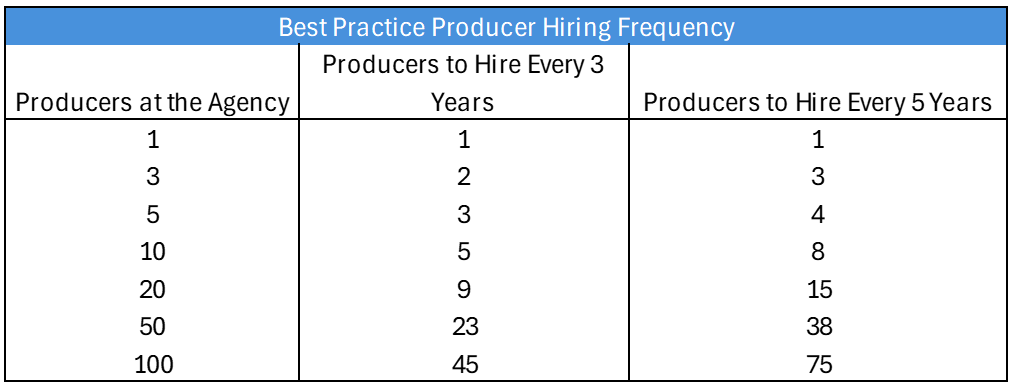
I think this metric is most useful for larger agencies that have already built a hiring engine. This metric breaks down for smaller agencies because, conceptually, a single- or two-producer agency, of which there are many, targeting a 15% producer velocity cannot hire 15% of a person or 30% of a person. However, this metric can still be helpful if we look at an extended period of time; see Figure 1. Regardless of how the numbers break down, the theme is the same: growth-minded agencies need to be looking to hire producers.
Think of Hiring as an Investment
I’ve seen many agencies that hoard cash on their balance sheet, citing “in case of emergency.” There is a difference between a rainy-day fund and a tsunami-season war chest. Meaning, some agencies may have too much cash just sitting around. Agencies that have enough scale to be constantly hiring producers typically have about 2% of their revenue going to unvalidated producers. This 2% of agency revenue is an investment. It’s the difference between what a producer is being paid and the agency commissions that their books generate. So, if you’re a larger agency, you can use this 2% investment as a target from the study.
For most agencies, this outlay sounds like a luxury. Not because they cannot afford it, but because they cannot find the producer talent to invest in in the first place. The less than $1.25M revenue group spent 0% on unvalidated producers, signaling that they didn’t have unvalidated producers. If you are an agency of this smaller size seeking to grow, prioritization is key. Priority one is to have a defined sales strategy you would be confident inviting a new producer into. The second priority should be a relentless commitment to finding producer talent. Expect to get burned and expect it to take many tries, but to really accelerate growth, you cannot just be a one-person show. When you go beyond a one-person show, it forces you to develop processes and procedures that are essential for scale.
Technology
With the 24/7 news feed bombarding everyone with conversations about data centers, companies like Anthropic and OpenAI, and the latest developments in artificial intelligence (AI), separating meaningful opportunities from the noise can be challenging. Independent insurance agents are always hearing about how the latest technology will disintermediate them. I do not think agents need to fear being replaced, but they should at least be curious as to how AI tools could benefit their operations. The Best Practice Study helps cut through this noise and provides insights into what agents are really doing today with AI tools.
How Much to Spend on Technology?
Let’s start with spending. Best Practice agencies across all revenue groups are spending, on average, between 3% and 3.6% of net revenue on technology. This number includes agency management systems (AMS), customer relationship management systems (CRM), and any investment in AI. Of an agency’s operating expenses, this technology expenditure would be in the top three expense categories, not including compensation expenses. Technology spending is important for all Best Practice agencies.
How Much AI is Being Used?
How many agencies have invested in AI tools? The results are a mixed bag. For agencies with revenue less than $25M, it is about a 50% chance that the agency has invested in AI tools, with the lower revenue groups being closer to a 1/3 or 2/5 chance that they’ve invested. As agencies scale and approach $100M or more in revenue, they are more likely to invest in AI. I think many agents are concerned they are falling behind by not having any AI tools implemented into workflows, but the data from the Best Practices Study shows that you are not behind. Agents need to be AI-curious, not necessarily AI-first. You need to consider an AI tool as a potential way to solve a problem.
What is AI Being Used For?
There are many ways agencies utilize AI daily, though a great example is for policy comparison and policy checking. 20-25% of agencies in the Best Practices Study reported using an AI tool to do policy comparison. The agencies using this tool well are using AI to do the initial 75% of the work, and then a human is finishing the workflow by doing the remaining 25% of the work. They use the tool to point out policy similarities, coverage differences, and potential gaps, then a human will come along and verify, drill down, and complete the policy comparison. The mistake would be completely outsourcing the critical thinking work of a policy comparison. That’s when an agent exposes themselves to an E&O claim.
The Best Practices Study reveals that agencies are certainly AI-curious, but there is not yet widespread adoption, and there is no data on the clear ROI of these tools.
Conclusion
The 2026 Best Practices Study Update had some important themes in regard to growth, hiring, and technology. Here are my three main takeaways:
- For growth during this softening market, as the rising tide now retreats, the agencies that truly have a sales culture will continue to grow while the others will slow down. From my seat as a valuation analyst and sell-side advisor, I see buyers analyzing organic growth much more closely. They are asking for books of business by carrier, by producer, by client count, by policy count. They want to understand what is really driving an agency’s growth beyond rate.
- For hiring, the Best Practice agencies need to have a great sales culture, but equally as important to growth is their ability to hire and develop producers. High-value agencies are the ones where the book is diversified across a deep roster of production talent, not just a book dependent on one “rainmaker.”
- For technology, widespread AI adoption does not exist yet. However, Best Practice agencies are exploring it. I think an agency professional needs to be curious and consider an AI tool as a potential way to solve problems, along with other technology or people solutions. Although widespread AI adoption is not here, Best Practice agencies do spend on technology like an AMS, CRMs, and ancillary tools as a top operating expense.
This year’s Best Practices Study did not disappoint. I hope that the school year and your favorite football team do not disappoint, either.
For the full 2026 Best Practices Study Update, visit: https://www.independentagent.com/2026-best-practices-study/
About the Author

Jarod Steed is the Business Planning and Valuation Analyst for OIA and the IA Valuations team. A graduate of The Ohio State University, he holds a Bachelor’s degree in Business Administration with a specialization in Finance and a minor in Economics. Jarod’s work background includes accounting and operations analysis in the Insurtech industry. He has a passion for delivering insightful numbers and thoughtful analysis. Jarod enjoys working closely with independent insurance agents in the valuation, consulting, and M&A space.